
Car Finance Soft Search vs Hard Search: What’s the Difference?
A car finance soft search will not affect your credit score, but a hard search can. Learn how each check works, when they happen and how long a hard search stays on your credit file.
Documents Needed for Car Finance: 6 Essential UK Checks

Documents Needed for Car Finance: 6 Essential UK Checks What documents do I need for car finance in the UK? Preparing the common evidence before you apply can help avoid delays. Understanding the documents needed for car finance before you begin can save time and prevent unnecessary delays. Whether you are buying your first car, upgrading to a newer model or exploring finance with a less-than-perfect credit history, having the right paperwork ready puts you in the strongest position for a smooth car finance application. Car finance requirements in the UK vary by provider, but you will typically need to confirm who you are, verify where you live and show how you can manage the repayments. Some lenders may also request employment details, recent bank statements and information about the vehicle you plan to purchase. This guide covers the documents needed for car finance in the UK, what different applicants may be asked to provide, and how to organise your car finance paperwork. Use the checklist to prepare your car finance application documents before applying. Documents Needed for Car Finance: 6-Category UK Checklist The FCA’s responsible lending rules require firms to make a reasonable creditworthiness assessment, including affordability. The evidence a lender asks for can vary by applicant and provider. The documents needed for car finance are outlined in the sections below. Document Common Examples Why It’s Needed Identity document Driving licence or passport To verify who you are Address confirmation Utility bill, council tax bill or bank statement To confirm where you currently live Income documentation Payslips, bank statements or tax calculations To evaluate your earning capacity Employment information Employer name, job title and employment status To understand your financial circumstances Bank details Account number and sort code To arrange repayments if finance is agreed Vehicle information Registration, price and seller details To assess the vehicle being financed Not every lender asks for every document at the beginning. Some can verify information electronically, while others may request further evidence before making a final decision. 1. Proof of Identity for Car Finance Typically, the first step when gathering documents needed for car finance is to verify your identity. Lenders need to make sure an applicant is genuinely the person named in the application. Identity verification also helps reduce the risk of fraud. What ID Do You Need for Car Finance? Depending on the finance provider, acceptable identification may include: Your identification should be current, clear and consistent with the personal information provided in your application. Do You Need a Driving Licence to Get Car Finance? Not every finance arrangement has identical driving licence requirements. Some lenders require a full UK driving licence, while others may consider applicants who can provide an alternative form of identification. The vehicle finance product and lender’s eligibility rules will determine what is acceptable. If you don’t hold a driving licence, check the specific requirements before applying rather than assuming that every provider will accept an alternative document. 2. Proof of Address for Car Finance A finance provider may ask for proof of your current residential address as part of its verification checks. This information helps confirm where you live and supports identity and credit assessments. What Counts as Proof of Address? Common examples include: Requirements for car finance in the UK vary by provider. Many lenders request address documents dated within the previous three months, although individual policies may differ. Your name and address should match the information supplied on your application. What If You’ve Recently Moved House? Moving home does not automatically prevent you from applying for car finance. Provide accurate current and previous addresses, including the dates you lived at each address. Some lenders request approximately three years of address history. Having your previous addresses and dates of residence ready can help avoid unnecessary delays. 3. Proof of Income for Car Finance Proof of income is particularly important because lenders must assess whether a proposed finance agreement is affordable. A car financing application is not based solely on your income. Lenders may also take into account your regular expenses, any existing loans you have, and other financial obligations. Do You Need Payslips for Car Finance? If you’re employed, a lender may ask for: Some lenders ask for several months of payslips or bank statements, while others use electronic verification or require fewer documents. For example, if your monthly salary is paid directly into your bank account, statements may help demonstrate a consistent income pattern. However, showing your earnings documentation does not guarantee approval. 4. Car Finance Documents for Self-Employed Applicants Self-employed applicants may need different income evidence because their earnings do not always follow a fixed monthly salary pattern. If you work for yourself, lenders may request: A lender may want to understand how stable your income is and whether it is sufficient to support the proposed repayments. Can You Get Car Finance with Irregular Income? Potentially, yes. Self-employed workers, contractors and freelancers may experience variations in their monthly income. Some lenders can assess these circumstances, although the evidence and eligibility requirements may be more detailed. For example, a contractor whose income varies throughout the year may need to demonstrate earnings over a longer period rather than relying on a single month’s payment. The important consideration is whether the lender can reasonably assess your ability to maintain repayments. 5. What If You Receive Benefits or a Pension? Not everyone applying for car finance earns a traditional salary. Some applicants receive income through pensions, certain benefits or a combination of sources. Depending on the lender, you may be asked for pension statements, benefit award letters or bank statements showing relevant payments. Different finance providers have different policies about the income they consider acceptable. Always provide accurate information about your income and avoid treating a particular type of payment as automatically acceptable to every lender. 6. Do You Need Bank Statements for Car Finance? Bank statements are commonly requested, but they are not always necessary for every application. Some lenders can verify income and
HP vs PCP vs Lease: Which Is Best for You in 2026?
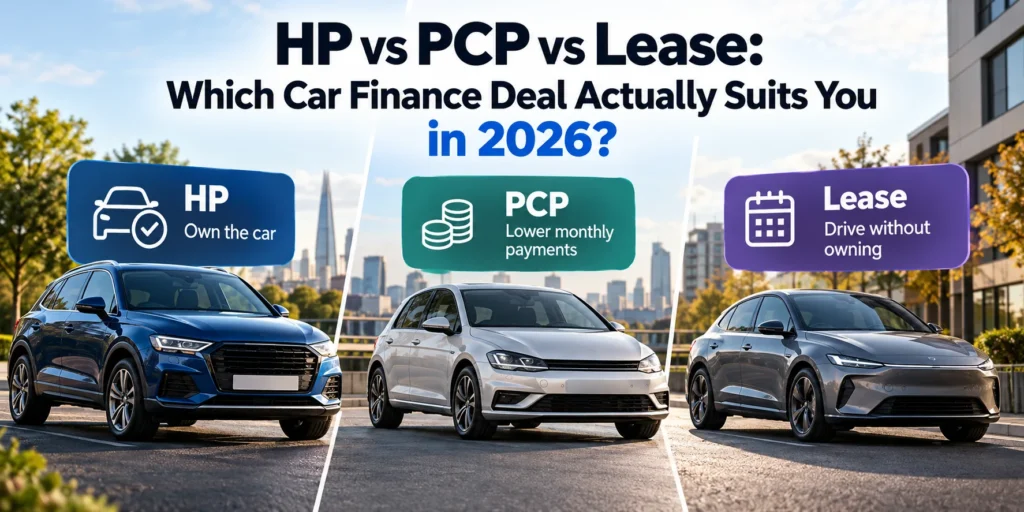
HP vs PCP vs Lease: Which Car Finance Deal Actually Suits You in 2026? HP vs PCP vs lease: which is best for you? Hire Purchase (HP) is usually suitable if you want to own your car after completing repayments. Personal Contract Purchase (PCP) can offer lower monthly payments and flexible end-of-agreement options. Leasing, commonly called Personal Contract Hire (PCH), lets you use a vehicle for an agreed period without buying it. The right choice depends on your budget, mileage, ownership preferences and how long you intend to keep the car. Imagine finding your ideal vehicle and receiving three completely different monthly quotations. One promises eventual ownership, another includes a large optional final payment, and the third requires you to return the vehicle. Suddenly, the lowest monthly instalment doesn’t seem like enough information. This guide explains how HP, PCP and leasing work in the UK in 2026, compares their actual financial implications and helps you choose an agreement that fits your circumstances. HP vs PCP vs Lease: What’s the Main Difference? The biggest difference between these arrangements is vehicle ownership. With HP, you make regular repayments towards owning the car. PCP gives you the option to purchase the vehicle through an agreed final payment, while leasing is a rental arrangement without a standard contractual purchase option. Although all three usually involve an upfront payment and regular instalments, they offer different outcomes when the agreement ends. Consider someone who wants a reliable family car for eight years. HP could suit their plan because they can finish repayments and keep driving without further finance instalments. Someone who enjoys upgrading every three years might prefer PCP or leasing. Neither approach is automatically wrong. The important question is whether you want to own the vehicle, keep your future options open or simply pay to use it. HP vs PCP vs Lease Comparison Table Each arrangement has advantages and restrictions that advertisements may not immediately explain. HP commonly involves higher regular payments than comparable PCP finance, but there is normally no large balloon payment. PCP can reduce monthly instalments by deferring part of the vehicle’s value. Leasing may offer competitive rentals, but it does not provide ownership rights. The following comparison summarises the typical features of each option. Actual contracts can differ, so always check the provider’s written terms. Feature HP PCP Lease (PCH) Main purpose Buy over time Use with option to buy Rent for a fixed term Upfront payment Usually deposit Usually deposit Usually initial rental Monthly payments Often higher than PCP Often lower than HP Depends on quotation Large optional final payment Normally no Usually yes No Ownership at contract end Yes, after conditions met Only if purchased No Mileage restrictions Generally no Usually yes Usually yes End-of-term options Keep the car Buy or return; possible part-exchange Return the car Main financial concern Higher instalments Balloon payment and conditions No ownership and return charges A comparison should consider total payments and what you receive at the end, not simply which monthly amount is lowest. A £250 lease and £350 HP agreement are not directly equivalent if the HP customer eventually owns the car. Likewise, a PCP agreement with low instalments may require substantial additional money to purchase the vehicle. Use the table to narrow your options before examining detailed quotations. What Is Hire Purchase (HP) Car Finance? Hire Purchase allows you to spread a vehicle’s purchase cost over an agreed repayment period. You normally pay a deposit followed by monthly instalments that include applicable interest. The finance company owns the vehicle during the agreement, with ownership transferring after the required payments, purchase fee where applicable and contractual conditions have been satisfied. Unlike PCP, HP normally does not include a substantial optional balloon payment. For example, suppose you buy a £14,000 used car with a £2,000 deposit. You would need to finance approximately £12,000 before any additional charges. Once you’ve made the scheduled repayments and satisfied the agreement, the vehicle becomes yours. That makes HP appealing if you want to drive the same car for several years after the finance finishes. CarFinanced explains the arrangement further in its HP car finance guide. What Are the Advantages and Disadvantages of HP? The main advantage of HP is its straightforward route to ownership. Monthly payments are generally fixed under a fixed-rate agreement, making budgeting easier. HP also normally avoids the contractual mileage restrictions associated with PCP and leasing. This can be useful if you commute long distances or regularly travel around the UK. However, HP instalments are often higher than comparable PCP payments because the financed purchase cost is repaid without a large deferred balloon payment. You also cannot freely sell the vehicle before ownership transfers without making suitable arrangements. Repairs, insurance and depreciation remain your responsibility. HP works best when ownership matters and the monthly payment is comfortably affordable. Who Should Choose HP? HP can suit families, long-distance commuters and drivers who prefer keeping vehicles for many years. If you cover 18,000 miles annually, having no standard PCP-style mileage allowance may be particularly valuable. Someone planning to maintain a reliable car after completing repayments may also benefit from the eventual absence of monthly finance instalments. However, consider the vehicle’s age and maintenance requirements before committing. Financing an older car over a long period could leave you paying instalments while facing expensive repairs. Compare reliability, insurance and servicing costs alongside the finance quotation. Choose HP because its ownership structure fits your plans, not simply because it is familiar. What Is Personal Contract Purchase (PCP)? Personal Contract Purchase combines a deposit, monthly repayments and an optional final payment. This final amount, commonly called the balloon payment, is linked to the vehicle’s estimated future value. Because a substantial amount is deferred, PCP monthly instalments are often lower than comparable HP payments. However, making every regular instalment does not automatically mean you own the vehicle. Imagine financing a newer hatchback that would be expensive under HP. PCP may reduce your monthly payment, giving you more flexibility during
How Much Car Finance Can I Get? UK Guide 2026

How Much Car Finance Can I Get? Understanding UK Lender Affordability Rules in 2026 How much car finance can I get in the UK? The amount depends on your income, monthly expenses, existing debts, credit history and the finance agreement you choose. There is no universal UK borrowing limit based on salary alone. Lenders must assess whether you can manage the proposed repayments, while your deposit, APR and repayment term affect the amount you could potentially borrow. Someone earning £30,000 annually may qualify for a different amount from another person with the same salary because their financial commitments are different. Buying a car should be exciting, but a tempting monthly payment can quickly become stressful if you overlook insurance, fuel and household bills. The smartest approach is to calculate your comfortable repayment budget before choosing a vehicle. This guide explains how UK lenders assess affordability in 2026, shows realistic borrowing examples and helps you compare finance options without making unnecessary commitments. How Much Car Finance Can You Get in the UK? There is no fixed maximum amount of car finance available to every UK borrower. Each lender applies its own eligibility requirements, product limits and creditworthiness assessment. Your available finance may depend on employment income, household expenditure, outstanding borrowing, deposit and the vehicle itself. For example, someone earning £2,500 monthly with relatively low expenses could have more financial flexibility than another applicant earning £3,200 but paying substantial rent, childcare and existing loan repayments. It’s also important to distinguish what a lender might approve from what you should comfortably borrow. A £400 monthly payment may technically fit an affordability assessment, but it could leave too little room for savings or unexpected expenses. Your ideal borrowing amount should allow you to maintain essential payments, cover vehicle running costs and preserve some financial flexibility. A larger approval is not automatically a better financial decision. What Determines Your Maximum Car Finance Amount? Lenders assess several connected factors rather than using salary as the only measure. Income helps establish your ability to repay, while rent, mortgages, credit cards and other commitments show how much money is already allocated. Credit history provides information about previous repayment behaviour, and the proposed APR and repayment term determine the cost of borrowing. Vehicle value, age and finance type may also affect the amount a lender is willing to offer. Your deposit can influence the calculation because it reduces the amount you need to finance. Suppose you want a £15,000 car and contribute £3,000 upfront. You would need approximately £12,000 of finance before any additional charges. However, a deposit cannot compensate for repayments that are otherwise unaffordable. The lender still needs to assess your financial circumstances and the proposed agreement. Is There a Minimum Salary for Car Finance? There is no universal minimum salary prescribed by the FCA for all car finance applicants. Individual lenders and brokers can apply their own income and eligibility requirements. Some applicants may qualify with relatively modest earnings if their expenses are manageable, while higher earners may be declined because of existing commitments or credit concerns. Employment type, income stability and the requested borrowing amount can also influence the decision. CarFinanced currently states a minimum income requirement of £1,000 per month for obtaining a quotation through its service, alongside other eligibility conditions. That is a provider-specific requirement, not a rule applied across the entire UK car finance market. Meeting an initial requirement does not guarantee finance approval. You should always check the provider’s current criteria and consider whether the proposed payments fit your actual budget. How Do UK Car Finance Lenders Check Affordability in 2026? UK lenders providing regulated consumer credit must carry out appropriate creditworthiness assessments before entering into relevant agreements. Under the FCA Consumer Credit sourcebook, CONC 5.2A, lenders consider both the risk of missed repayments and the risk that repayments could be unaffordable for the customer. This means looking beyond whether someone has borrowed successfully in the past. Lenders must consider whether the proposed payments can be made sustainably. However, the FCA does not require every lender to use one identical checklist or a fixed salary percentage. Assessment methods must be appropriate and proportionate to the circumstances. One application may involve additional income verification, while another may be assessed using different reliable information. The important point is that approval should be supported by a reasonable assessment of creditworthiness and affordability. What Income and Employment Details Do Lenders Consider? Lenders may consider regular employment earnings, sustainable self-employed income and other income reasonably available for repayments. They can also assess how reliable those earnings are likely to remain during the finance term. Someone with a fixed monthly salary may have different verification requirements from a freelancer whose income changes throughout the year. Depending on the lender and circumstances, supporting evidence could include payslips, tax documents or bank statements. If you earn overtime or commission, avoid assuming that your highest earning month represents your normal income. Imagine regularly taking home £1,900 but occasionally earning £2,600 during busy periods. A finance payment calculated around £2,600 could become uncomfortable when overtime disappears. Using dependable income provides a more realistic basis for long-term borrowing. How Do Living Expenses and Existing Debts Affect Approval? Your essential expenditure influences how much income remains available for a new agreement. Lenders may consider rent, mortgage payments, household bills, childcare, existing loans and other relevant commitments. Someone with several outstanding credit agreements may have less borrowing flexibility than another applicant with the same salary and fewer obligations. This is why the amount arriving in your bank account tells only part of the affordability story. Consider two applicants who each take home £2,400 monthly. One pays £700 towards housing and £150 towards debt, while the other pays £1,100 towards housing and £400 towards existing borrowing. Their available budgets could be substantially different even before food, utilities and car running costs are included. A lender must assess the relevant circumstances rather than assume both applicants can afford identical repayments. What Credit Score Do You