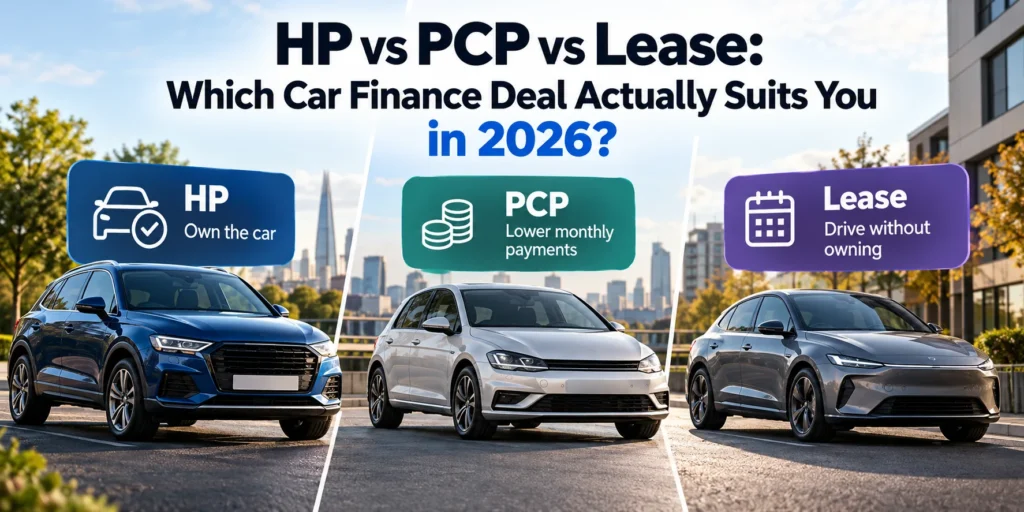
HP vs PCP vs Lease: Which Car Finance Deal Actually Suits You in 2026?
HP vs PCP vs lease: which is best for you? Hire Purchase (HP) is usually suitable if you want to own your car after completing repayments. Personal Contract Purchase (PCP) can offer lower monthly payments and flexible end-of-agreement options. Leasing, commonly called Personal Contract Hire (PCH), lets you use a vehicle for an agreed period without buying it. The right choice depends on your budget, mileage, ownership preferences and how long you intend to keep the car.
Imagine finding your ideal vehicle and receiving three completely different monthly quotations. One promises eventual ownership, another includes a large optional final payment, and the third requires you to return the vehicle. Suddenly, the lowest monthly instalment doesn’t seem like enough information. This guide explains how HP, PCP and leasing work in the UK in 2026, compares their actual financial implications and helps you choose an agreement that fits your circumstances.
HP vs PCP vs Lease: What’s the Main Difference?
The biggest difference between these arrangements is vehicle ownership. With HP, you make regular repayments towards owning the car. PCP gives you the option to purchase the vehicle through an agreed final payment, while leasing is a rental arrangement without a standard contractual purchase option. Although all three usually involve an upfront payment and regular instalments, they offer different outcomes when the agreement ends.
Consider someone who wants a reliable family car for eight years. HP could suit their plan because they can finish repayments and keep driving without further finance instalments. Someone who enjoys upgrading every three years might prefer PCP or leasing. Neither approach is automatically wrong. The important question is whether you want to own the vehicle, keep your future options open or simply pay to use it.
HP vs PCP vs Lease Comparison Table
Each arrangement has advantages and restrictions that advertisements may not immediately explain. HP commonly involves higher regular payments than comparable PCP finance, but there is normally no large balloon payment. PCP can reduce monthly instalments by deferring part of the vehicle’s value. Leasing may offer competitive rentals, but it does not provide ownership rights.
The following comparison summarises the typical features of each option. Actual contracts can differ, so always check the provider’s written terms.
| Feature | HP | PCP | Lease (PCH) |
|---|---|---|---|
| Main purpose | Buy over time | Use with option to buy | Rent for a fixed term |
| Upfront payment | Usually deposit | Usually deposit | Usually initial rental |
| Monthly payments | Often higher than PCP | Often lower than HP | Depends on quotation |
| Large optional final payment | Normally no | Usually yes | No |
| Ownership at contract end | Yes, after conditions met | Only if purchased | No |
| Mileage restrictions | Generally no | Usually yes | Usually yes |
| End-of-term options | Keep the car | Buy or return; possible part-exchange | Return the car |
| Main financial concern | Higher instalments | Balloon payment and conditions | No ownership and return charges |
A comparison should consider total payments and what you receive at the end, not simply which monthly amount is lowest. A £250 lease and £350 HP agreement are not directly equivalent if the HP customer eventually owns the car. Likewise, a PCP agreement with low instalments may require substantial additional money to purchase the vehicle. Use the table to narrow your options before examining detailed quotations.
What Is Hire Purchase (HP) Car Finance?
Hire Purchase allows you to spread a vehicle’s purchase cost over an agreed repayment period. You normally pay a deposit followed by monthly instalments that include applicable interest. The finance company owns the vehicle during the agreement, with ownership transferring after the required payments, purchase fee where applicable and contractual conditions have been satisfied. Unlike PCP, HP normally does not include a substantial optional balloon payment.
For example, suppose you buy a £14,000 used car with a £2,000 deposit. You would need to finance approximately £12,000 before any additional charges. Once you’ve made the scheduled repayments and satisfied the agreement, the vehicle becomes yours. That makes HP appealing if you want to drive the same car for several years after the finance finishes. CarFinanced explains the arrangement further in its HP car finance guide.
What Are the Advantages and Disadvantages of HP?
The main advantage of HP is its straightforward route to ownership. Monthly payments are generally fixed under a fixed-rate agreement, making budgeting easier. HP also normally avoids the contractual mileage restrictions associated with PCP and leasing. This can be useful if you commute long distances or regularly travel around the UK.
However, HP instalments are often higher than comparable PCP payments because the financed purchase cost is repaid without a large deferred balloon payment. You also cannot freely sell the vehicle before ownership transfers without making suitable arrangements. Repairs, insurance and depreciation remain your responsibility. HP works best when ownership matters and the monthly payment is comfortably affordable.
Who Should Choose HP?
HP can suit families, long-distance commuters and drivers who prefer keeping vehicles for many years. If you cover 18,000 miles annually, having no standard PCP-style mileage allowance may be particularly valuable. Someone planning to maintain a reliable car after completing repayments may also benefit from the eventual absence of monthly finance instalments.
However, consider the vehicle’s age and maintenance requirements before committing. Financing an older car over a long period could leave you paying instalments while facing expensive repairs. Compare reliability, insurance and servicing costs alongside the finance quotation. Choose HP because its ownership structure fits your plans, not simply because it is familiar.
What Is Personal Contract Purchase (PCP)?
Personal Contract Purchase combines a deposit, monthly repayments and an optional final payment. This final amount, commonly called the balloon payment, is linked to the vehicle’s estimated future value. Because a substantial amount is deferred, PCP monthly instalments are often lower than comparable HP payments. However, making every regular instalment does not automatically mean you own the vehicle.
Imagine financing a newer hatchback that would be expensive under HP. PCP may reduce your monthly payment, giving you more flexibility during the agreement. But you must understand the amount required if you eventually want ownership. Interest and other charges can also make the full agreement more expensive than the monthly figure suggests. CarFinanced provides further explanations in its PCP car finance guide.
Why Are PCP Monthly Payments Often Lower Than HP?
PCP monthly payments are typically lower because part of the vehicle’s value remains outstanding as an optional final payment. This deferred amount is commonly based on the Guaranteed Minimum Future Value (GMFV). The regular instalments therefore follow a different structure from HP, where the financed purchase cost is generally repaid throughout the agreement.
However, lower monthly payments do not necessarily mean less interest overall. Interest can be charged with reference to the deferred amount as well as the balance repaid through regular instalments. Before choosing PCP, compare the deposit, APR, total amount payable and balloon payment. A manageable monthly figure is useful only when the entire agreement makes financial sense.
What Happens at the End of a PCP Agreement?
At the scheduled end of PCP, you normally have the option to pay the balloon payment and own the vehicle or return it under the contract’s conditions. Part-exchange may also be possible, especially if the vehicle’s market value exceeds the relevant finance settlement figure. However, positive equity is never guaranteed.
Suppose your optional final payment is £8,000 and the vehicle is worth £9,500. There might be £1,500 of potential equity before additional costs. If the vehicle is worth only £7,000, there may be no positive equity. Returning it through the normal PCP return option can still be possible without paying that market-value shortfall, although mileage, condition and other contractual requirements apply. Never assume your current PCP will automatically fund your next deposit.
Who Should Choose PCP?
PCP may suit drivers who want a relatively newer vehicle and value flexibility when the agreement ends. It can be appealing if you expect to change cars every three or four years, provided the mileage allowance matches your driving habits. Regular instalments may also be easier to accommodate than comparable HP repayments.
The disadvantage is that you may never own the vehicle unless you pay the optional final amount. Repeated PCP agreements can also mean ongoing monthly payments for many years. If you want to keep your next car long-term, compare PCP’s full ownership cost against HP rather than assuming lower instalments mean better value.
What Is Car Leasing (Personal Contract Hire)?
Car leasing, or Personal Contract Hire, allows you to rent a vehicle for an agreed period, commonly two to four years. You usually pay an initial rental followed by regular monthly payments. The leasing provider retains ownership, and you normally return the vehicle when the agreement finishes. Standard PCH contracts do not provide a contractual right to purchase the car.
For example, a driver might lease a newer electric vehicle for three years because they prefer changing cars as technology develops. They can use the vehicle throughout the agreed period without needing to arrange its resale afterwards. However, the contract will typically specify a mileage allowance, vehicle condition requirements and potential early termination charges. MoneyHelper’s Personal Contract Hire guidance explains these responsibilities in detail.
What Are the Advantages and Disadvantages of Leasing?
Leasing can offer predictable rental payments and convenient access to newer cars. It removes the need to organise a private sale when the rental period ends. Some providers also offer maintenance packages, although these may cost extra. For people who don’t want ownership, these features can be valuable.
The main disadvantage is that your rental payments do not build vehicle ownership. You must also follow mileage and condition requirements, and ending a lease early can be expensive. Insurance, fuel or charging and other operating expenses remain relevant. Leasing can be suitable, but only when returning the vehicle is an outcome you’re comfortable with.
Can You Buy a Car at the End of a Lease?
A standard PCH agreement does not provide an agreed purchase option. Unlike PCP, there is no contractual balloon payment that transfers ownership to you. Some providers may separately offer to sell a vehicle, but that possibility should never be assumed when choosing leasing.
Imagine becoming attached to a reliable car after three years and wanting to keep it. If you’re leasing, your agreement may still require you to return it. You would then need to arrange another vehicle at the prices available at that time. If eventual ownership matters, HP or PCP is usually a more appropriate starting point.
HP vs PCP vs Lease: Which Is Cheapest Overall?
The cheapest option depends on the agreement’s complete cost and your intended outcome. HP may have higher monthly payments but leave you owning a vehicle. PCP may cost less each month yet require a substantial final payment for ownership. Leasing may offer lower rentals, but you usually finish without a car to keep or sell.
To compare fairly, use the same vehicle, similar contract lengths, realistic mileage and complete written quotations. Consider both the amount paid and the value of any vehicle you own at the end. Two contracts with identical monthly payments may deliver entirely different long-term financial outcomes.
A Realistic Example of Total Payments
Imagine comparing three hypothetical 36-month arrangements for a £20,000 car. One HP agreement requires a £2,000 deposit and 36 payments of £575. A PCP arrangement requires £2,000 upfront, 36 payments of £350 and an optional £9,000 final payment. A lease requires a £1,500 initial rental followed by 35 payments of £295. These examples are illustrations, not actual quotations using equivalent financing rates.
The following table shows why comparing the complete contract matters.
| Illustration | HP | PCP | Lease |
|---|---|---|---|
| Upfront payment | £2,000 | £2,000 | £1,500 |
| Regular payments | 36 × £575 | 36 × £350 | 35 × £295 |
| Initial and regular payments | £22,700 | £14,600 | £11,825 |
| Optional purchase payment | None | £9,000 | Not available |
| Total if purchased | £22,700 | £23,600 | Not applicable |
| Normal end position | Own car | Return or purchase | Return |
These are fictional contract examples, not market averages or lender quotations. Fees, return charges, insurance and operating costs are excluded. The lease assumes its initial rental replaces the first monthly rental.
In this example, leasing has the lowest scheduled payment total, but the vehicle must normally be returned. HP costs more during the agreement but leads to ownership. PCP offers a lower regular commitment while preserving an option to buy. Comparing actual offers requires considering vehicle value, finance charges and your intended ownership outcome, not simply ranking these totals.
How Do Mileage Limits and Return Charges Affect PCP and Leasing?
PCP and leasing commonly include agreed annual mileage allowances. These might be 6,000, 10,000 or 15,000 miles, depending on the provider. Lower allowances may reduce advertised payments, but exceeding the limit can result in additional charges when returning the car. HP generally has no comparable contractual mileage restriction.
Vehicle condition also matters. Fair wear and tear may be acceptable, while significant damage, missing equipment or neglected maintenance could lead to charges. Before signing, ask for the mileage rate, condition standards and return procedure. Do not choose an unrealistically low mileage allowance simply to make monthly payments appear cheaper.
Which Is Best for High-Mileage Drivers or Families?
High-mileage drivers often benefit from HP’s lack of standard contractual mileage limits. If you commute long distances or regularly drive across the UK, predicting exact mileage over several years can be difficult. HP may also appeal to families who want a practical vehicle they can keep after repayments finish.
However, PCP and leasing can still suit higher-mileage customers when appropriately priced allowances are available. The real issue is the total cost of a contract matching your driving needs. Families should also consider boot space, child-seat compatibility, reliability and repair costs. The best finance product cannot compensate for buying the wrong vehicle.
Which Is Best if You Change Cars Every Few Years?
PCP and leasing can suit drivers who prefer changing vehicles regularly. PCP offers end-of-term choices, including purchasing the car, while leasing focuses on returning it after a fixed rental period. Both may be attractive when access to newer vehicles matters more than long-term ownership.
But regularly changing cars can mean continuing payments indefinitely. A new agreement may also have a different price, APR or rental amount. If your main goal is reducing long-term motoring costs, buying a reliable car and keeping it after repayments finish may be worth considering. Convenience should be weighed against the financial cost of repeated agreements.
How Do Credit Scores and Affordability Affect Your Options?
Finance providers consider credit history, income, financial commitments and other relevant information when assessing applications. For regulated lending, the FCA’s CONC 5.2A rules require appropriate creditworthiness assessments, including affordability. Leasing providers also commonly perform credit checks, although the contractual and regulatory framework differs from HP and PCP.
There is no single credit score that guarantees approval for every product. Applicants with previous credit difficulties may face fewer available options or higher borrowing costs. A higher salary does not automatically guarantee acceptance either. Assess your realistic monthly budget before deciding which agreement to pursue.
Can You Get HP or PCP With Bad Credit?
Some lenders consider applicants with poor credit histories, although approval is not guaranteed. Previous missed payments, defaults, existing debts and income stability may affect the decision. HP and PCP eligibility depends on the lender’s criteria and the proposed agreement’s affordability.
If your credit history is limited or damaged, compare the full cost of any offer carefully. An expensive APR can make an attractive vehicle unsuitable for your budget. Consider reducing the amount borrowed rather than automatically accepting costly finance. A soft-search eligibility check, where available, may help you explore options before making a formal application.
What Should You Check Before Signing a Car Finance Agreement?
Before signing HP or PCP, review the cash price, deposit, amount of credit, APR, monthly repayments, fees and total amount payable. With PCP, also check the balloon payment, mileage allowance and return conditions. With leasing, review the initial rental, scheduled payments, maintenance responsibilities, mileage restrictions and termination charges.
Think about whether you could still afford the agreement if household bills increased or your earnings fell. Insurance, servicing, tyres, fuel and unexpected repairs can substantially increase the monthly cost of motoring. Do not rely on a salesperson’s verbal explanation when the written agreement says something different. An informed decision is more valuable than rushing to secure a vehicle.
Can You End HP, PCP or Leasing Early?
HP and PCP agreements may provide early settlement options and statutory voluntary termination rights, depending on the agreement and circumstances. Voluntary termination is subject to legal conditions and potential financial liabilities. It should not be confused with simply returning a vehicle and stopping payments.
Leasing agreements generally do not have the same statutory voluntary termination arrangements. Ending a PCH agreement early can involve substantial contractual charges. If your circumstances may change, investigate these conditions before signing. Ask the provider for clear written information about settlement or termination costs.
How to Choose Between HP, PCP and Leasing in 2026
Start with your long-term plan. If you want to own the car and keep it, HP is often a sensible option. If you want lower regular payments and understand the optional final payment, PCP may be suitable. If ownership isn’t important and you prefer fixed-term vehicle use, leasing deserves consideration.
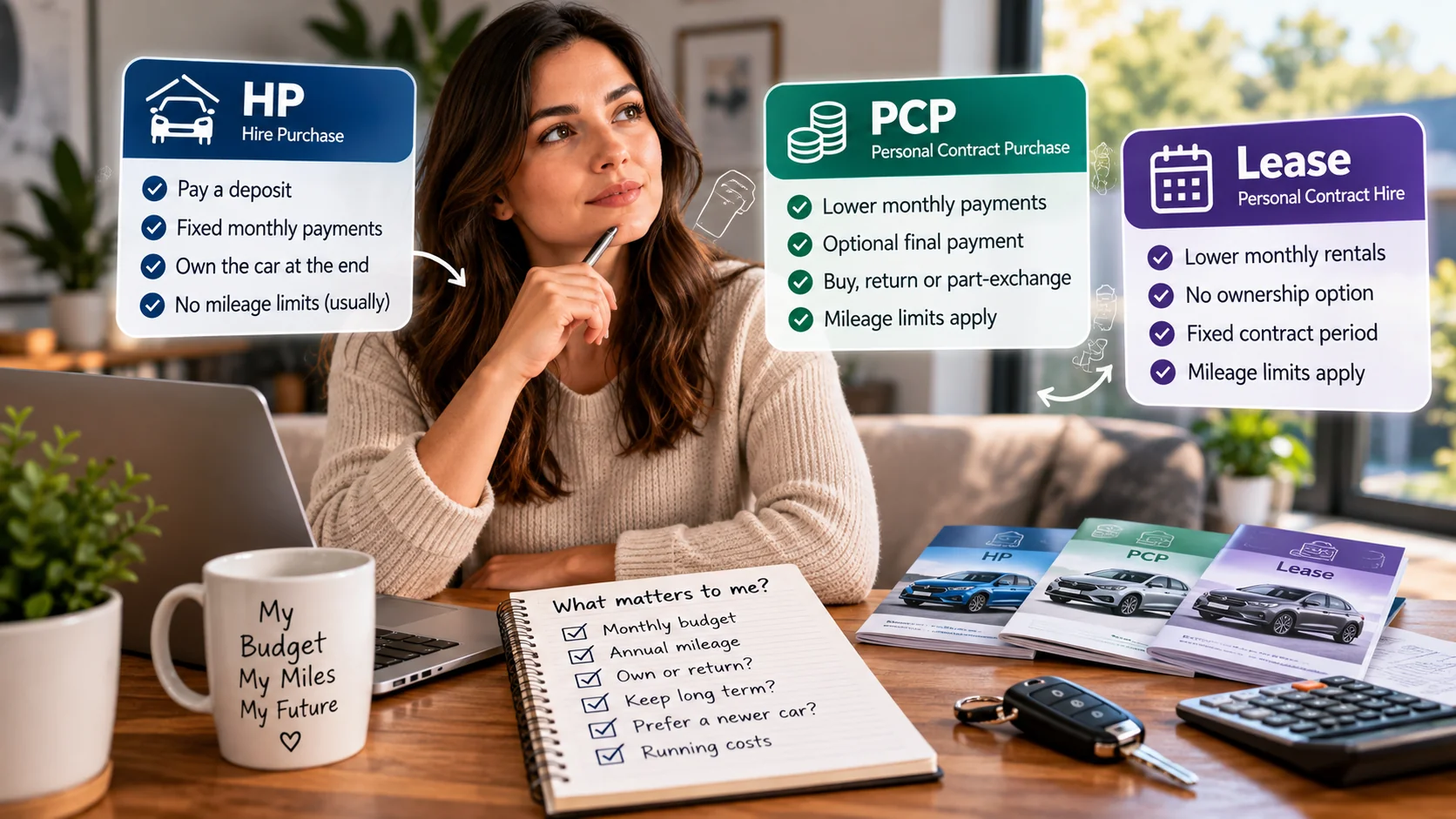
Next, compare your actual monthly budget, expected mileage, upfront costs and total contract commitments. Request personalised quotations rather than relying on representative examples. CarFinanced offers HP and PCP options but does not currently provide leasing, so compare independent lease quotations separately if that is your preferred route. You can use the CarFinanced finance calculator to explore illustrative borrowing costs.
Conclusion: Is HP, PCP or Leasing Right for You?
The answer to HP vs PCP vs lease depends on what you value most. HP offers a structured route towards owning your vehicle. PCP provides lower monthly instalments in many comparable cases, alongside an optional purchase decision. Leasing lets you use a vehicle without committing to ownership. Each arrangement has different costs, restrictions and end-of-term outcomes.
Before applying, decide whether you want ownership, predictable vehicle access or flexibility to change cars. Calculate the complete cost and ensure repayments leave room for essential expenses and emergencies. Avoid choosing an expensive vehicle simply because the advertised monthly payment looks manageable. The right agreement is one you understand and can comfortably afford throughout its term.
People Also Ask: HP vs PCP vs Lease FAQs
Is HP Better Than PCP?
HP may be better if you want ownership without a large balloon payment. PCP may suit those who prefer lower regular instalments and end-of-term choices.
Is Leasing Cheaper Than PCP?
Leasing can have lower monthly rentals, but you normally return the vehicle. Compare complete costs and ownership outcomes before deciding.
Do You Own the Car After HP?
Yes, ownership normally transfers once you’ve made the required payments and satisfied the agreement’s conditions, including any applicable purchase fee.
Can You Own a Car After PCP?
Yes. You normally need to pay the optional final balloon payment and meet the relevant agreement conditions to become the owner.
Can You Buy a Leased Car?
Standard PCH leasing does not include a contractual purchase option. Any separate sale depends on the provider and should never be assumed.
Which Is Best for High-Mileage Drivers?
HP often provides more flexibility because it generally has no contractual mileage limit. PCP and leasing typically have mileage allowances.
Does PCP Have a Balloon Payment?
Yes. PCP usually includes an optional final payment, which you must make if you want to buy the vehicle outright.
Can You Get HP or PCP With Bad Credit?
Potentially. Some lenders consider applicants with poor credit, but rates may be higher and approval depends on affordability and eligibility.
Can You End a Car Lease Early?
Some contracts allow early termination, but significant charges may apply. Ask your leasing provider for the contractual costs before proceeding.
Does Leasing Include Insurance?
Usually not. Drivers generally arrange insurance separately, while maintenance packages may be available depending on the provider.
Is PCP Better for Changing Cars?
PCP can suit drivers who change vehicles regularly, provided they understand the final payment, mileage limits and potential absence of equity.
Which Car Finance Option Is Best for First-Time Buyers?
There is no universal best choice. Compare affordability, insurance, ownership goals, driving mileage and the complete agreement cost.